.png)

Deeptech in Southeast Asia: What Separates Innovation from Scalable Businesses?
Rather than representing a single industry, deeptech encompasses businesses built around proprietary scientific or engineering advances that create meaningful technical barriers to replication. In DealStreetAsia’s Southeast Asia Deep Tech Review 2025, the cohort spans healthtech, greentech, data analytics and machine learning, software and IT, and industrial technologies, with AI treated increasingly as an enabling layer across these verticals rather than a standalone category.
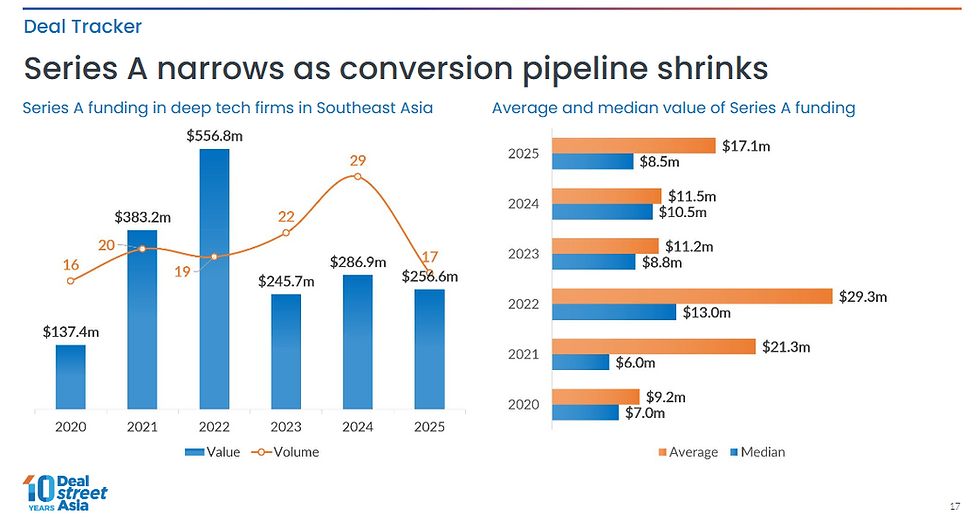
Southeast Asia’s funding trajectory reflects this tension between growing investor interest and greater selectivity. Deeptech is therefore taking a larger role within the regional venture market, but rising capital is being distributed across fewer deals, pointing to greater concentration around companies able to command stronger investor conviction.Total deeptech funding rose 19% year on year to $999.2 million in 2025, even as deal volume declined from 117 transactions in 2024 to 109. Deeptech also accounted for 23.6% of total venture-backed deal volume, up from 18.5% in 2024 and 10.9% in 2020, while its share of funding value reached 18.7%.
A closer look at the funding funnel suggests that the principal constraint lies in converting them into businesses capable of sustaining follow-on capital. In 2025, 94.5% of Southeast Asia’s deeptech deals remained early-stage, while the pool narrowed substantially thereafter. Series A activity fell from 29 deals in 2024 to 17 in 2025, and only four Series B rounds were recorded across the region. The sharp drop-off as companies progress through the funding cycle suggests that technical differentiation is only an initial condition; continued access to capital increasingly depends on evidence of commercial viability, scalability and durable value creation.

Technological novelty may create the basis for a moat, but it does not, on its own, constitute a compelling investment case. The more fundamental question is therefore: what converts technical advantage into scalable commercial value? This article examines that transition through three practical milestones, technical proof, commercial proof and scale proof, and illustrates how these milestones have played out across successful deeptech companies in Southeast Asia.
2. From Technical Proof to Commercial Proof to Scale Proof
In a highly selective Southeast Asia’s capital environment, as DealStreetAsia describing a shift toward fewer, larger and more selective bets, investors are concentrating capital around companies with clearer technical moats, proven commercial demand and more visible paths to scale. BCG’s deeptech investment life cycle helps explain this progression: scientific risk dominates early research, followed by engineering and unit-economics risk, then commercialisation and scalability as ventures mature. For Southeast Asian founders, these can be simplified into three practical milestones: technical proof, commercial proof and scale proof.

2.1. Technical Proof
According to BCG (2021), technical proof is evidence that a deeptech technology can deliver its intended performance under commercially relevant conditions, not only under controlled laboratory conditions. For physical deeptech, this includes whether performance remains compatible with manufacturability, reliability and design-to-cost requirements as the technology moves toward application. BCG notes that processes that work in the laboratory frequently fail at scale, while physical-product scale-up requires engineering challenges to be solved.
BCG also finds that 96% of deeptech ventures combine at least two technologies, 66% use multiple advanced technologies and 83% develop physical products, creating dependencies across materials, hardware, manufacturing processes and software. The relevant technical milestone is therefore the parameter that materially changes the application’s economics, such as yield, throughput, energy use, reliability or cost per unit, rather than technical novelty in isolation.
Singapore provides a concrete regional model for shortening the distance between laboratory proof and industry-grade validation. Enterprise Singapore’s Startup SG Tech explicitly supports both Proof-of-Concept and Proof-of-Value for proprietary technologies. A*STAR extends this pathway into industrial test bedding: its S$62 million Low-Carbon Technology Translational Testbed (LCT³) operates under industry-relevant conditions and is designed to move technologies from laboratory Proof-of-Concept (PoC) through Proof-of-value (PoV) to the first pilot data required to demonstrate scalability. The value of such infrastructure is not simply that it accelerates R&D, but that it allows founders to test whether a technical advantage remains reliable, manufacturable and economically meaningful outside the laboratory.
For founders, this changes what should count as technical proof. The objective is not to maximise a laboratory metric in isolation, but to generate evidence that the metric survives increasingly realistic conditions and continues to improve the economics of the intended application. Shared testbeds, corporate pilots and translational programmes can therefore help founders identify failure points earlier—whether in yield, reliability, throughput, energy use or manufacturability—before committing substantial capital to scale-up. In this sense, strong technical proof reduces engineering uncertainty by showing that the technology is not only scientifically feasible, but sufficiently robust to justify the next stage of commercial validation.
2.2. Commercial Proof
Commercial proof is evidence that a technically validated solution can overcome the economic, regulatory and organisational barriers required for customers to adopt and pay for it. It therefore goes beyond technical performance: the product must fit customer workflows, procurement requirements and market economics well enough to generate credible demand. This is a significant challenge in deeptech because technical readiness does not automatically create market readiness. BCG–Hello Tomorrow found that while 95% of deeptech startups sought long-term corporate partnerships, only 57% had secured them, and 61% cited market access as a major need. The gap illustrates that even technically credible ventures may struggle to convert performance into adoption when customers, channels or procurement pathways are not yet established.
For regulated sectors, Southeast Asia is beginning to develop mechanisms through which validation in one market can reduce entry friction in another. In medtech, for example, regulatory-reliance arrangements allow eligible devices assessed by Singapore’s Health Sciences Authority to undergo shorter review pathways in Malaysia and Thailand. Malaysia can reduce the relevant review period from 60 to 30 working days, while Thailand’s reliance pathway can shorten review times from roughly 150 to 60 working days. More than 450 HSA-registered devices have received approvals through reliance pathways across Australia, Malaysia and Thailand.
These mechanisms do not by themselves establish commercial demand, but they remove one barrier between technical validation and customer adoption by making parts of the evidence base reusable across jurisdictions.
For founders, the implication is to build commercial proof sequentially: establish a credible reference market, determine which evidence, regulatory, technical or customer-based, can travel, and then validate the remaining local barriers before expanding. In a fragmented Southeast Asian market, commercial proof is therefore not simply about entering more countries, but about showing that adoption can be reproduced as market-specific frictions are progressively removed.
2.3. Scale Proof
Scale proof is evidence that a technology’s performance and unit economics remain stable as production volume and operating complexity increase. BCG treats this as a distinct risk from technical validation because processes that work in the lab can fail at scale, while physical-product scale-up requires engineering solutions to remain within design-to-cost parameters.
This matters because scale introduces process variability that may not appear at prototype stage. In biomanufacturing, for example, McKinsey finds that more than 1,000 process parameters can influence yield for a single product–process combination; closing the gap between average and best-achievable yields could reduce cost of goods manufactured by nearly 10%. Scale proof is therefore not simply higher output, but evidence that yield, throughput, quality and cost remain controlled as operating complexity rises.
Southeast Asia’s manufacturing depth can help founders test these assumptions earlier, but it is an enabler of scale proof rather than the proof itself. Malaysia provides a strong example: it contributes approximately 13% of global semiconductor assembly, testing and packaging volume, with established clusters in Penang and other industrial centres spanning advanced packaging, testing and system integration. Programmes such as MYChipStart also support companies from prototype realisation through post-silicon validation and qualification, giving hardware ventures access to production-relevant infrastructure before committing to full-scale capacity.
For founders, the implication is to leverage this manufacturing ecosystem to validate what is most likely to deteriorate as volume rises, not simply to secure factory capacity. Access to suppliers, packaging, testing and manufacturing partners can shorten the path to industrial validation, but scale proof is only established when yield, quality, throughput, lead times and unit economics continue to hold under higher-volume conditions. Malaysia’s ecosystem therefore creates a useful environment in which those scale assumptions can be tested; it does not substitute for proving them.
3. What This Looks Like in Practice
Southeast Asia’s deeptech landscape is increasingly shaped by different national strengths rather than a single ecosystem model. DealStreetAsia’s 2025 review highlights Singapore and Malaysia as beneficiaries of the region’s growing role in semiconductor and technology supply chains. Singapore has developed the region’s deepest research-to-commercialisation infrastructure, while Malaysia combines a growing deeptech pipeline with established semiconductor and industrial capacity; Thailand is also building a credible pathway in regulated medtech and advanced manufacturing.
These different ecosystem advantages are reflected in the pathways taken by successful companies. Singapore’s Nanofilm converted university-developed surface-engineering IP into proprietary equipment and high-volume industrial production; Malaysia’s Qarbotech moved carbon-quantum-dot research from university validation into a commercial agricultural product; and Thailand’s Meticuly translated university research in AI-assisted 3D-printed implants through Thai, US and European regulatory pathways into 1,000+ clinical cases and international deployment. Together, the cases show that the route from technical proof to commercial and scale proof is shaped not only by the technology, but by how effectively founders use the scientific, regulatory and industrial capabilities available in their home ecosystems.
3.1. Nanofilm
Nanofilm is an NTU spin-off specialising in advanced surface solutions, built around its patented Filtered Cathodic Vacuum Arc (FCVA) technology. FCVA enables the deposition of high-performance thin-film coatings across applications including consumer electronics, automotive and precision engineering, with advantages in adhesion, hardness, film density and low-temperature deposition. Rather than relying on the patent itself as the primary source of defensibility, the company built an integrated capability spanning proprietary advanced materials, coating processes, in-house software and coating equipment. Its Industrial Equipment business also designs and manufactures equipment for internal use, reducing reliance on third parties as production scales.

By FY2019, this integrated model had generated S$142.9 million in revenue, including S$109.6 million from its Advanced Materials business. Its 2020 IPO subsequently valued the company at approximately S$1.9 billion, making Nanofilm Singapore’s first local deep-tech unicorn to be listed on the SGX. The case illustrates how a scientific advantage can become substantially more defensible when the company also controls the materials, processes and production infrastructure required to reproduce it reliably at industrial scale.
3.2. Qarbotech — Malaysia
Qarbotech is a Universiti Putra Malaysia spin-off commercialising QarboGrow, a carbon-quantum-dot photosynthesis enhancer designed to help crops utilise light more efficiently. The initial challenge was not purely scientific, but commercial: founder Suraya Abdul Rashid had previously spent roughly a decade working on advanced nanomaterials in what she later described as a largely “technology-push” model, with a difficult path to commercialisation. Agriculture provided a more clearly defined application, but prospective farms and plantations still required substantially more field-validation data before committing to the product.

Qarbotech therefore built commercial proof progressively. Suraya received a market-validation grant from UPM’s InnoHub in 2017, leading to Harvast as an early product for home gardeners. The company continued collecting user data and testimonials before commercialising Harvast in 2020 and later developing QarboGrow for the agricultural market in 2022. By July 2026, the technology was being used by nearly 7,500 farmers worldwide, while Qarbotech had recorded nearly RM3 million in 2025 sales. The case illustrates that commercial proof in agritech depends not only on technical efficacy, but on accumulating credible field evidence and reducing the practical friction of adoption.
3.3. Meticuly — Thailand
Meticuly is a Chulalongkorn University spin-off combining AI-assisted design with titanium 3D printing to produce patient-specific implants from individual CT scans. Conventional off-the-shelf implants typically come in standard sizes and may require surgeons to reshape them during surgery; Meticuly instead converts CT data into an AI-assisted patient-specific design before 3D printing the resulting implant. Its end-to-end workflow reduced turnaround to approximately 2–7 days, while eliminating much of the intraoperative adjustment required by standardised implants.
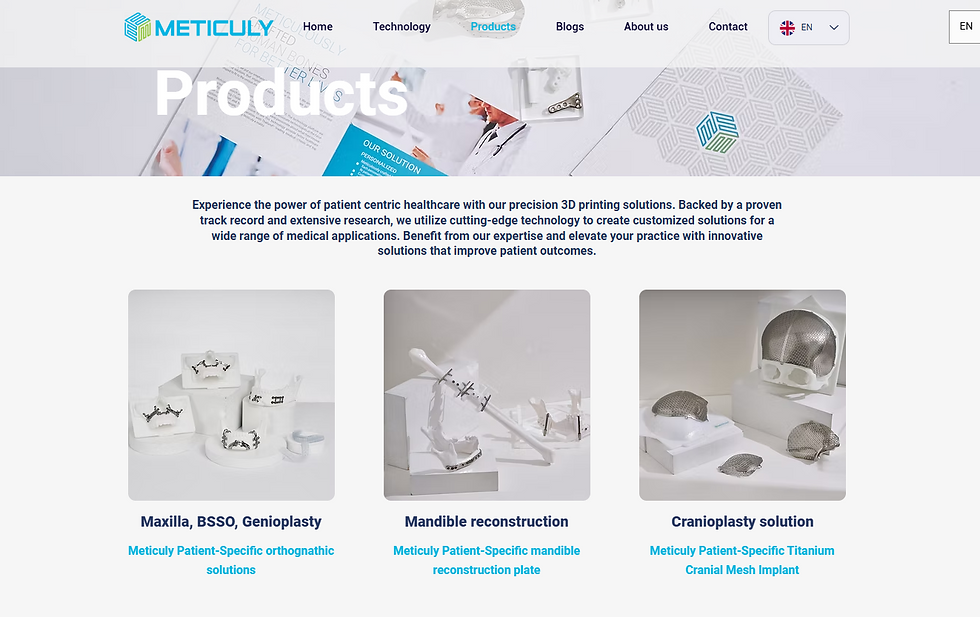
In regulated medtech, however, technical performance alone was insufficient. As it expanded, Meticuly progressively built the regulatory infrastructure required for broader market access, securing Thai FDA approval, ISO 13485 certification and US FDA 510(k) clearances for its cranial and maxillofacial products. Its first US clearance was granted in 2021, followed by further approvals as the company expanded internationally. By 2026, Meticuly reported more than 2,700 cases across 260+ hospitals. The case illustrates how medtech scale depends on clearing two distinct constraints: regulatory legitimacy to access markets and a production workflow capable of delivering personalised products within clinical timelines.
4. Outlook
Southeast Asia’s next deeptech opportunity lies in connecting increasingly specialised national capabilities into a regional commercialisation system. Singapore provides research depth and translational infrastructure, reinforced by the S$37 billion RIE2030 plan; Malaysia offers semiconductor and advanced-manufacturing capacity; Vietnam brings large-scale electronics production and global supply-chain integration; and Thailand contributes a mature automotive base increasingly oriented toward EV and next-generation manufacturing. Together, these complementary capabilities create the basis for a regional pathway linking research, validation and industrial scale-up across markets.
The remaining challenge is to make these capabilities easier to connect across the lab-to-market and scale-up journey. The region’s concentration of funding at earlier stages is consistent with a broader gap between technical validation and sustained commercial expansion. For founders, this means building with regional scalability in mind and identifying early where testing, manufacturing, regulatory or customer capabilities may need to come from outside the home market. Investors, in turn, can play a more active role in bridging technical and commercial milestones through patient, milestone-based capital and cross-border industry networks. Policymakers can further reduce cross-border friction in validation, procurement and scale-up the regional opportunity is therefore not simply to generate more deeptech companies, but to connect Southeast Asia’s existing strengths into a more continuous path from scientific innovation to commercially validated and scalable businesses.
References
500 Global (2024): Daily Markup 1126: Qarbotech’s photosynthesis hack holds the promise of food security & carbon offsetting for Malaysia, https://500.co/content/daily-markup-1126-qarbotechs-photosynthesis-hack-holds-the-promise-of-food-security-carbon-offsetting-for-malaysia
Agency for Science, Technology and Research [A*STAR] (2026): The Low-Carbon Technology Translational Testbed (LCT³), https://www.a-star.edu.sg/isce2/lct3
Bernama (2026): Malaysian Agritech Startup Qarbotech Expands Global Footprint, https://www.bernama.com/en/news.php?id=2586022
Boston Consulting Group (2017): What Deep-Tech Startups Want from Corporate Partners, https://www.bcg.com/publications/2017/technology-digital-joint-ventures-alliances-what-deep-tech-startups-corporate-partners
Boston Consulting Group (2021): Deep Tech and the Great Wave of Innovation, https://www.bcg.com/publications/2021/deep-tech-innovation
Boston Consulting Group (2023): An Investor’s Guide to Deep Tech, https://web-assets.bcg.com/a8/e4/d3f2698b436aa0f23aed168cd2ef/bcg-an-investors-guide-to-deep-tech-nov-2023-1.pdf
Collaborative Research in Engineering, Science and Technology [CREST] (2026): MYChipStart, https://crest.my/mychipstart/
DealStreetAsia (2026): Deep tech takes larger share of SE Asia venture market despite wider funding crunch, https://www.dealstreetasia.com/stories/southeast-asia-deep-tech-review-2025-485576
Malaysian Investment Development Authority [MIDA] (2025): Beyond Assembly Lines: Powering Malaysia’s Rise in Semiconductor and High-Tech Frontiers, https://www.mida.gov.my/beyond-assembly-lines-powering-malaysias-rise-in-semiconductor-and-high-tech-frontiers/
McKinsey & Company (2025): Human–machine harmonization to upgrade biopharma production, https://www.mckinsey.com/capabilities/operations/our-insights/human-machine-harmonization-to-upgrade-biopharma-production
Meticuly (2024): Meticuly and Siriraj Hospital unveil world’s first titanium 3D printing system to manufacture regulatory-compliant implants at point-of-care, https://www.meticuly.com/post/meticuly-and-siriraj-hospital-unveil-titanium-3d-printing-system-at-point-of-care
The Edge Malaysia (2024): Agritech: Boosting crops with quantum tech, https://theedgemalaysia.com/node/733123
U.S. Food and Drug Administration [FDA] (2021): 510(k) Premarket Notification: K210099 – Meticuly Patient-Specific Titanium Mesh Implant, https://www.accessdata.fda.gov/scripts/cdrh/cfdocs/cfpmn/pmn.cfm?ID=K210099
World Intellectual Property Organization [WIPO] (2022): Meticuly: 3D Printed Bone Replacements that Fit Patients, https://www.wipo.int/en/web/ip-advantage/w/stories/meticuly-3d-printed-bone-replacements-that-fit-patients

