.png)

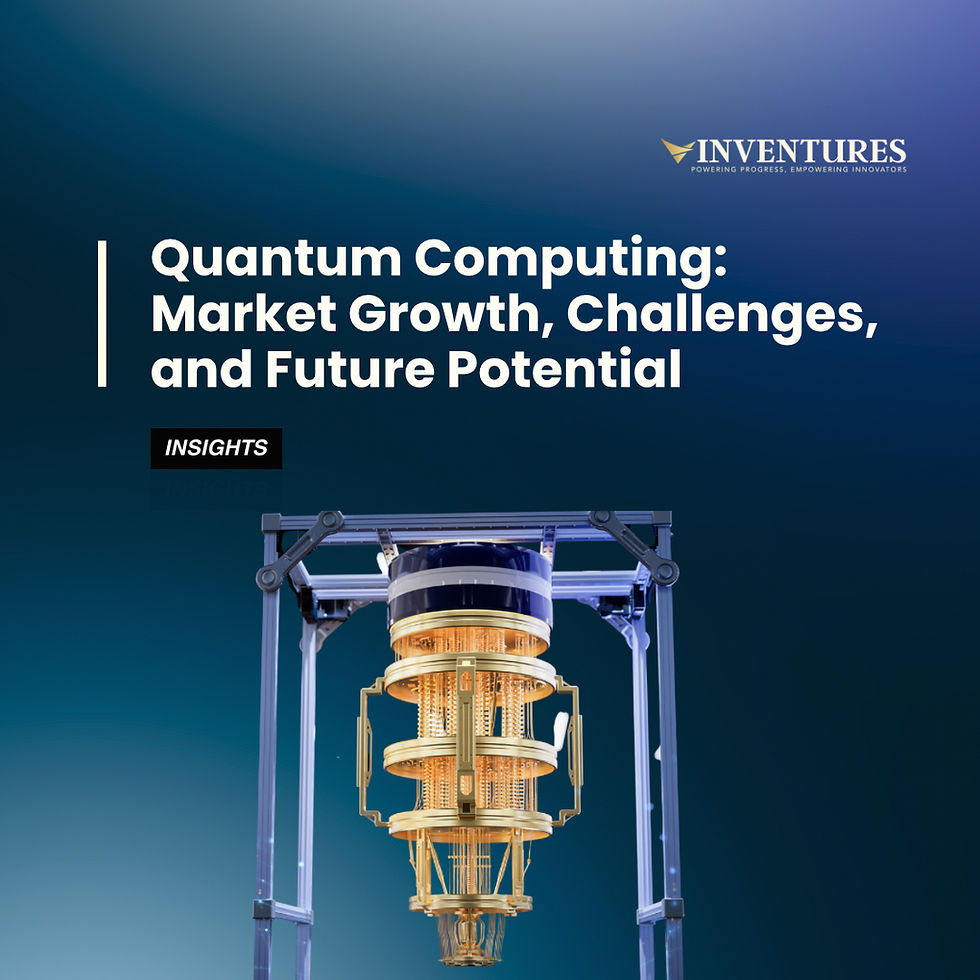
Quantum Computing: Market Growth, Challenges, and Future Potential
Updated: Jul 29
Quantum technology is moving from theory to reality. After decades in the lab, it is beginning to show real commercial promise, drawing growing attention from governments, companies, and investors around the world.
According to the Quantum Index Report by MIT (2025), many researchers now describe this moment as the start of a second quantum revolution. The first translated the strange rules of the quantum world into technologies that underpin modern life, semiconductors, lasers, Magnetic Resonance Imaging (MRI) machines, and atomic clocks. The second goes a step further: directly controlling quantum systems, using qubits for computing or entangled photons for communication.
As quantum technologies move closer to practical use, understanding what they are, and where they stand today, becomes increasingly important. This article provides an overview of quantum computing, its core ideas, the current state of the technology, the key bottlenecks, and the outlook ahead.
1.What is quantum computing?
Quantum computing is a new computing paradigm that uses the laws of quantum physics to solve certain problems far more efficiently than classical computers. Instead of processing information sequentially, quantum systems can explore many possibilities simultaneously. Classical computers process information using bits, which can take one of two values: 0 or 1. Quantum computers use quantum bits (qubits). Unlike classical bits, a qubit can exist as 0, 1, or a combination of both at the same time. This property, known as superposition, allows quantum systems to represent and process many possible states simultaneously.
![Classical computing vs. quantum computing [Illustration] by Cori Lin. (2025). Onibaba Studio. - Source: Block Club Chicago](https://static.wixstatic.com/media/e8b2da_e7c0496bf8af450d9073f6781ec1805f~mv2.png/v1/fill/w_980,h_653,al_c,q_90,usm_0.66_1.00_0.01,enc_avif,quality_auto/e8b2da_e7c0496bf8af450d9073f6781ec1805f~mv2.png)
When multiple qubits interact, the number of possible system states grows exponentially due to Quantum Superposition, which allows qubits to exist in combinations of 0 and 1 simultaneously. This enables quantum computers to represent and explore many possible solutions at once rather than evaluating them sequentially.
A second key property, Quantum Entanglement, further enhances computational power. Entangled qubits become strongly correlated, meaning the state of one qubit directly influences another, allowing coordinated operations across the system.
Quantum computing is particularly suited to problems that involve simulation, optimization, and complex probabilistic modelling, areas where classical computing struggles as complexity grows.
Potential applications include:
Drug discovery and materials science: simulating molecules and chemical reactions with high precision
Finance: optimizing portfolios, risk modelling, and fraud detection
Supply chains and mobility: solving large-scale optimization problems in logistics and traffic systems
Cybersecurity: both challenging existing encryption and enabling new secure communication methods such as quantum key distribution
In short, quantum computing does not replace classical computing. Instead, it opens a new class of computational capability, one designed to tackle problems that are currently impractical or impossible to solve.
2.Where does quantum computing stand today?
Quantum technology is transitioning from a primarily research-driven field to an emerging commercial market. According to analysis from McKinsey & Company (2025), global interest in quantum technologies continues to expand across governments, research institutions, and private investors. Recent investment trends reflect this shift: public funding for quantum technology startups increased from 15% of total investment in 2023 to 34% in 2024, while private investment declined from 85% to 66%, highlighting growing government involvement in the sector.

The broader quantum technology ecosystem is typically divided into three core segments: quantum computing, quantum communication, and quantum sensing. Market projections indicate that the combined quantum technology sector could generate up to $97 billion in annual global revenue by 2035. Some forecasts suggest the market could reach nearly $200 billion by 2040, reflecting both technological progress and broader enterprise adoption.
Among the three segments, quantum computing is expected to capture the largest share of value, reflecting its potential to transform computationally intensive tasks such as molecular modeling, optimization, and cryptography. This market alone is projected to grow from approximately $4 billion in 2024 to between $28 billion and $72 billion by 2035, depending on the pace of technological progress and enterprise adoption.
Other segments are also expected to grow steadily. Quantum communication, which enables ultra-secure data transmission through quantum encryption and quantum key distribution, is projected to reach $11 billion to $15 billion by 2035 as cybersecurity demands increase and governments invest in secure communication infrastructure.
Quantum sensing, which uses quantum phenomena to enable extremely precise measurements, could generate $7 billion to $10 billion in revenue, with applications emerging in navigation, medical imaging, environmental monitoring, and defense.
The distribution of economic value will likely vary by industry. Early adoption is expected in sectors where quantum capabilities can address complex computational or measurement challenges. Chemicals, life sciences, financial services, and mobility are widely viewed as leading candidates for early commercial applications due to their reliance on large-scale simulations, optimization problems, and secure data systems.
According to the insights from Quantum Index Report by MIT (2025), multiple indicators suggest the ecosystem is expanding quickly:
Patents: Quantum technology patents increased fivefold between 2014 and 2024, while quantum computing patent filings alone grew more than 300% between 2016 and 2021. Corporations and universities account for 91% of total filings.
Geographic leadership: China holds roughly 60% of global quantum technology patents, followed by the United States and Japan.
Research output: The United States leads in high-impact quantum computing research, while China leads in quantum communication research, particularly through large-scale satellite quantum communication projects.
Venture funding: Quantum startups raised over $2 billion in 2024, including $1.6 billion for quantum computing companies and $621 million for quantum software firms. The United States and United Kingdom together account for more than 60% of global venture investment in the sector.
Hardware development: Today, more than 40 commercial quantum processors (QPUs) are available globally, with over 160 systems currently in development or planning stages across 17 countries.
Governments are also playing a major role. National initiatives in countries such as the United States, China, and across the European Union are investing billions of dollars to accelerate research, develop talent pipelines, and establish global leadership in the field.
3.What challenges remain and what is the future outlook for quantum computing?
Despite rapid progress in quantum hardware, several major technical barriers still limit the development of large-scale quantum computers. Most challenges fall into two broad categories: qubit reliability and system scalability.
3.1 Qubit errors and the need for error correction.
Qubits are extremely sensitive to environmental noise, imperfect operations, and decoherence. Even small disturbances can corrupt quantum information and disrupt calculations. To perform reliable computations, quantum systems must implement Quantum Error Correction, which encodes information across multiple redundant qubits to detect and correct errors.
This creates two levels of computation: physical qubits, the hardware-level qubits in a processor, and logical qubits, which are error-corrected qubits built from many physical qubits. Because error correction requires redundancy, hundreds or even thousands of physical qubits may be needed to produce a single logical qubit, meaning practical quantum computers will require very large hardware systems. In addition, error correction only works when hardware performance reaches extremely high precision.
Many protocols assume two-qubit gate fidelities above 99.99%, which remains a difficult engineering target.
3.2 Scaling to millions of qubits.
Even if qubits become reliable, quantum computers must scale to very large sizes before meaningful applications become possible. Current estimates suggest that many important use cases could require millions of physical qubits.
For example, running Shor’s Algorithm to break RSA-2048 encryption may require roughly 20 million qubits using current error-correction methods. Other applications may require fewer resources. Quantum chemistry simulations could require 4–5 million qubits, while some scientific simulations may require around one million qubits. Resource estimates for optimization and machine learning remain uncertain because scalable quantum algorithms are still under development.
Today’s quantum computers are far smaller, typically containing tens to hundreds of qubits, with only a few experimental systems approaching the thousand-qubit scale.
3.3 The limits of current quantum hardware.
Most existing quantum processors belong to the Noisy Intermediate-Scale Quantum (NISQ) era. These systems cannot yet perform large-scale error correction and therefore struggle to run long, complex quantum algorithms. Although researchers are exploring possible near-term uses for NISQ systems, convincing demonstrations of sustained commercial advantage remain limited. As a result, most experts believe that large-scale, fault-tolerant quantum computers will be required before quantum computing can deliver widespread practical value.
3.4 Timeline outlook.
Estimating when large-scale quantum computers will emerge remains uncertain, but several indicators provide guidance. Industry roadmaps show major developers targeting processors with hundreds of thousands to millions of qubits over the next decade, although earlier projections of million-qubit machines by 2030 have shifted to more conservative timelines.
Expert surveys suggest that a cryptographically relevant quantum computer, capable of breaking modern encryption, has roughly a 50% probability of appearing within 15–20 years. Hardware scaling trends also indicate that, if qubit counts continue to grow exponentially, million-qubit systems could emerge between the mid-2030s and early-2040s.
Taken together, these signals suggest a gradual development path: larger experimental processors and early logical qubits in the late 2020s, the first fault-tolerant systems enabling specialized applications in the early to mid-2030s, and broader commercial impact as hardware and algorithms mature later in the decade. Under many realistic assumptions, the first economically meaningful quantum applications may emerge around 2035, although significant uncertainty remains.
References:
Block Club Chicago. (2025, February 6). What is quantum computing?https://blockclubchicago.org/2025/02/06/what-is-quantum-computing/
Iberdrola. (n.d.). What is quantum computing?https://www.iberdrola.com/about-us/our-innovation-model/what-is-quantum-computing
Koen Groenland (2025). Intro to Quantum. .https://introtoquantum.org/essentials/timelines/
IBM. (2025). What is quantum computing?https://www.ibm.com/think/topics/quantum-computing
McKinsey & Company. (2025). The year of quantum: From concept to reality in 2025.https://www.mckinsey.com/capabilities/tech-and-ai/our-insights/the-year-of-quantum-from-concept-to-reality-in-2025
McKinsey & Company. (2024). Quantum communication: Growth drivers, cybersecurity, and quantum computing.https://www.mckinsey.com/capabilities/tech-and-ai/our-insights/quantum-communication-growth-drivers-cybersecurity-and-quantum-computing
Ruane, J., Kiesow, E., Galatsanos, J., Dukatz, C., Blomquist, E., Shukla, P., “The Quantum Index Report 2025”, MIT Initiative on the Digital Economy, Massachusetts Institute of Technology, Cambridge, MA, May 2025.